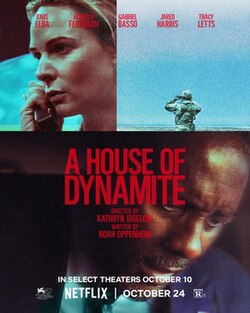
A House Full of Dynamite
The first time I ever watched a thriller about how the United States would react to an end of the world scenario, I was with my dad staring wide eyed at a television that got exactly three channels. One of the reasons The Andromeda Strain worked so well was that the filmmakers captured what people believed about the government’s capabilities; their ability to handle a humongous, time sensitive event. Watching today’s film really made me wonder how differently a Gen Z’er might react as opposed to how the Boomer sitting here typing this is reacting. I grew up on the serious knowledge the world could die horribly any second. How well does this work on someone without that background? Please comment below if you have any thoughts on it, I’m really curious.
It’s immediately obvious this is a beautifully shot film, and there is great setup to the thriller dynamic from the first moments, beginning with the title cards:
“At the end of the Cold War global powers reached the consensus that the world would be better off with fewer nuclear weapons”
“That era is now over”
“Inclination is flattening” [makes sense in the story]
At a buttoned up, tiny military base in the far north of the mainland United States, nuclear threat first responders go about their lives. They’ve trained and practiced for the possibility that adversaries from somewhere else in the world might lose their mind and actually launch a nuclear weapon at us. Suddenly, it’s not training or practice anymore. Because they’re front line, their part in events is over very quickly, leaving every man and woman on the base devasted. The film then moves to another front.
Good-looking shots and nearly monster movie music from the first moments introduces the story with the stark beauty of military assets and the realization that very young people have our lives in their hands. There is protocol, technology, training, and some understanding of the fears that most of the world lived with for a long time but has been mostly forgotten. This good setup of a tiny room a thousand miles from civilization connected to and then merged with the seat of power in the U.S. capitol. The mechanisms cranked up immediately at the White House Situation Room. I quickly turned to my viewing companion and quipped, “Well, we know it’s a fantasy because there is intelligence, coordination, and human emotions at play.”
At the tiny first responder war room, we at first hear and then begin to see the people at the other end they’re working with, until the story focuses more squarely with the DC war room and we hear the dialogue from the people we were first acquainted with. I liked this structure quite a bit because it allowed the same threat to send a thrill to the audience more than once. The overarching events that everyone responds to stays the same, but the story is told more than once from differing, linked perspectives.
There are muddled reports fired at people who must make quick decisions affecting millions or perhaps billions of people. Opinions and scenarios of the who and the why and the what ifs are overlaid over the main event. I thought some of those deeply world political scenarios before they were uttered onscreen, which made my experience at least even more deeply felt. This felt too real, like that movie my dad and I watched decades ago. And the technology was fascinating as well. There is a quick shot of a massive, floating radar system in the Pacific that made me say, “Oh, cool!” Separating that long ago movie from this one is the sure knowledge that, then, the filmmakers used belief in the government’s abilities to ground the story. This time around, the filmmakers showed us a scenario that the viewer will wish the government could react well, but now there is skepticism that works just as well as the long-ago trust.
I was quickly struck by the filmmaker giving the viewer not a few great, heartbreaking moments. Because of the structure of the film a couple of them are revisited. The format is great for keeping the thrill element from wearing out too soon, and I was impressed. Then I saw who directed the movie.
Kathryn Bigelow (Near Dark, Zero Dark Thirty, The Hurt Locker) is the first woman to win Best Director and The Hurt Locker won Best Picture, for telling compelling stories that come at a worn trope from just enough of a different angle to make them fresh. The main actors listed, Idris Elba (Thor, The Dark Tower, Cats) and Rebecca Ferguson (Doctor Sleep, Dune, Mission Impossible) are just the tip of the iceberg of strong talent that you will recognize once you see them. One is an actor with a long career of bad guy shenanigans who is redeemed here. Even some of the tiny roles are filled with well-known actors like Kathryn Deavers (Booksmart, The Last of Us).
There are a lot of moving parts in the film that fit seamlessly together. World views will be tested at the choices that must be made in no time and will undoubtedly hit differently according to generation. The three-act structure is beautifully integrated and adds a lot to the power of the film, allowing tension and heartache to build time and again from the same event. It’s a film shot with an understated beauty, augmented by great sound design and music. This is the kind of film you could enjoy very much with a crowd of friends who might get into a (hopefully friendly) argument over how they believe the characters should or should not react, or even at one point discuss how they think a character MIGHT HAVE reacted. I recommend it and was really surprised at how affected I was.
Triggers: loads of suspense
Available on: Netflix, Prime Video
LINKS:
- A House Full of Dynamite – Official Netflix Site
- A House Full of Dynamite – IMDB
- A House Full of Dynamite – Wikipedia
CFR: In Addition
Well huh. I might have come to a point where I can predict how Cranky feels about the movie in a few sentences. I often detect a “tone” to their writing that indicates how much enjoyment is in the flick. When I started reading this review, I felt I was reading an intense essay. I can to go through the entire review to realize the high esteem Cranky holds for this movie. Gravitas is even a word I would use.
Now they had me at Kathryn Bigelow. The first woman to win an Academy Award for Best Director! HUZZAH! I actually watched that live. It was good. So when I saw her name I immediately got curious about the movie and had to watch. (BTW: Zero Dark Thirty, a Bigelow movie, is a masterpiece and she should have gotten Best Director for that too.) After reading what the movie is about and a quick plot summary I would say that yes, that sounds like an amazing Bigelow movie and of course big names wanted to work with her because talent calls to talent, and no way in heck at the moment will I watch.
I’m sure it is good, fantastic even. I mean BIGELOW! But my generation sat together on Saturday nights and made plans to walk to ground zero if the bombs dropped. Yeah. Decades later, my fear has somewhat waned. However I do not need to watch something that could bring that up. Too much dread in my heart already. Maybe when I am 80…
At any rate, watch this flick if you think you might even maybe like it. Bigelow is great and so is Cranky.

